EPR Registration Explained: What Every Manufacturer & Importer Must Know

What Is LMPC Registration?

LMPC stands for Legal Metrology Packaged Commodities. LMPC registration is the Rule 27 registration that records the name, address and commodities of a manufacturer, packer or importer dealing in pre-packaged goods. It sits under the Legal Metrology Act, 2009, administered by the Department of Consumer Affairs.

People often call it an “LMPC licence” or “LMPC certificate”. Technically it is a registration. It tells the regulator who is responsible for a package. It does not certify that your product is safe, high quality or correctly labelled.

Who Needs LMPC Registration?

You should assess LMPC registration if you:

  • Import goods packed for retail sale, such as household items, stationery, accessories or personal care products
  • Manufacture or pack goods in India under your own or another brand
  • Repack imported goods in India
  • Sell packaged goods online and are the importer, packer or manufacturer of record

Bulk goods sold to industrial or institutional buyers may qualify for exemptions, but printing “not for retail sale” on a carton does not create an exemption on its own. The underlying supply must meet the legal conditions.

LMPC Registration Rules 2026: Five Changes You Cannot Ignore

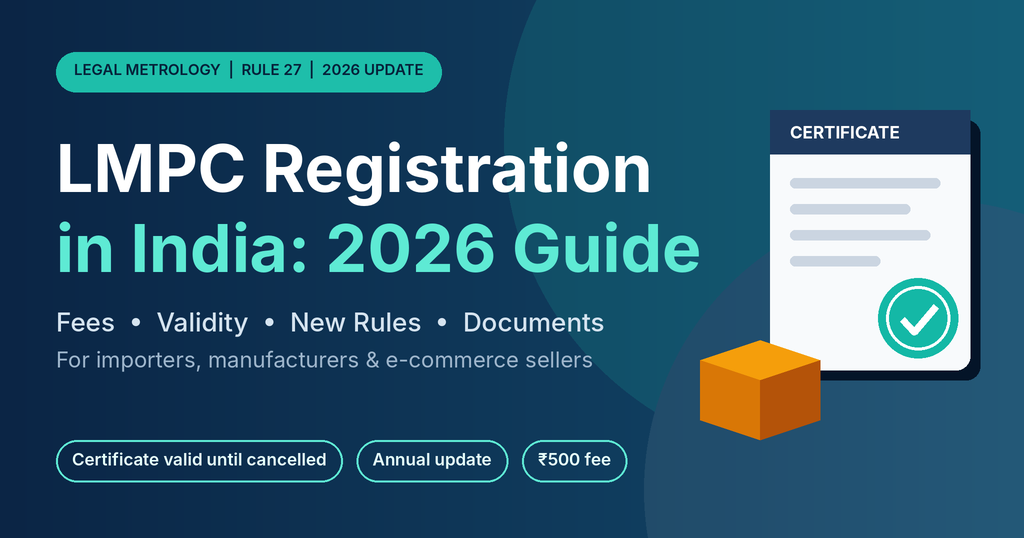
The Third Amendment Rules, 2026 state that Rule 27 certificates stay valid until cancelled. The old five-year renewal cycle no longer applies.

Validity without expiry does not mean zero maintenance. Companies and firms must update changed particulars each year on the designated portal, including address, products handled and country of origin.

For companies, the application now identifies the director responsible for violations under the Act and rules. Align this with your internal authorizations.

The rules allow required declarations to be affixed on imported packages under defined conditions. An October 2026 advisory distinguishes qualifying AEO Tier-2 and Tier-3 importers, who may use approved premises, from other importers, who must complete labelling in the specified customs or importer bonded warehouses before home-consumption clearance.

Under the Jan Vishwas (Amendment of Provisions) Act, 2026, a Legal Metrology Officer can issue an improvement notice for specified first-time procedural violations. If you correct the issue within the stated period, penal action is avoided. Failure to comply, or repeating the violation, brings penalties back. This covers areas such as registration, documentation, imports and transactions in packaged commodities.

LMPC Registration Fees and Timeline

  • Government application fee: ₹500
  • Alteration of the certificate: ₹100
  • Application window: departmental guidance points to 90 days from starting the relevant importing or packing activity

Professional fees from consultants are separate. Ask any provider to split statutory fees from service charges. Processing time depends on the application route, document completeness and any queries raised, so treat consultant timelines as estimates, not government guarantees.

Where to Apply for LMPC Registration: Which Authority?

Rule 27 routes applications to the Director or Controller of Legal Metrology. In general, importers apply to the central Director of Legal Metrology, while manufacturers and packers apply to their state Controller, with the central route applying where operations span several states. Always confirm the current route for your case, because central and state systems differ in forms and checklists.

LMPC Registration Documents Required

  • Incorporation or partnership records, PAN and GST details
  • Import Export Code (IEC) for importers
  • Premises details for import, storage or repacking locations
  • Commodity list with pack formats, quantities and countries of origin
  • Responsible director details (companies)
  • Sample labels or artwork

Keep names and addresses identical across every document. Mismatches are a common cause of queries.

LMPC Registration Process: Step by Step

  • Assess your products. Identify whether you handle finished retail packs, wholesale supplies or goods for repacking.
  • Confirm the correct authority and current form.
  • Compile your application file and check documents against each other.
  • Submit the application and pay the fee, saving the acknowledgement.
  • Reply to observations completely and consistently.
  • Verify the certificate for name, address and commodity accuracy, and set up an annual review.

Mandatory Label Declarations Under the Packaged Commodities Rules

  • Holding a certificate does not make your packs compliant. Imported retail packages generally need:

    • Name and address of the manufacturer, packer or importer
    • Country of origin, manufacture or assembly
    • Common or generic name of the product
    • Net quantity in standard units (not gross shipping weight)
    • Maximum Retail Price, inclusive of all taxes
    • Manufacturing or import date and shelf-life details where relevant
    • Consumer-care contact details

    Some products also need dimensions or unit sale price. Review the printed sample, not just the on-screen artwork.

LMPC for Amazon and Flipkart Sellers: Two Different Deadlines

  • Mixing these up is the most common mistake right now:

    • 1 January 2027: The Consumer Protection (E-Commerce) Amendment Rules, 2026 take effect. Platforms must show mandatory declarations, including the full country of origin for imported goods, and additional entity disclosures.
    • 1 July 2027: The searchable and sortable country-of-origin filter for imported product listings becomes mandatory. It was first notified in February 2026 for July 2026, then pushed back.

    If you sell on Amazon, Flipkart, Meesho or your own site, keep a clean product-origin data sheet now so listings can be updated quickly.

LMPC vs Legal Metrology Licence and Other Approvals

LMPC does not replace your IEC, BIS certification, FSSAI or cosmetics permissions, or customs conditions. An electronic product, for example, may need several separate approvals. Treat LMPC as one layer of compliance.

Common Mistakes to Avoid

  • Treating the certificate as label approval
  • Copying foreign packaging without Indian declarations
  • Assuming every B2B sale is exempt
  • Using the country of shipment as the country of origin
  • Ignoring the annual update
  • Fixing label problems only after the shipment lands
  • Following outdated advice on five-year renewal
LMPC Registration for Importers: Practical Checklist
  • Confirm LMPC applicability before placing the purchase order
  • Approve final artwork with all declarations before production
  • Plan where any Indian labelling will happen (bonded warehouse or approved premises)
  • Nominate the responsible director
  • Diarise the annual portal update
  • Review listings against the 1 January 2027 and 1 July 2027 dates
Conclusion
  • Confirm LMPC applicability before placing the purchase order
  • Approve final artwork with all declarations before production
  • Plan where any Indian labelling will happen (bonded warehouse or approved premises)
  • Nominate the responsible director
  • Diarise the annual portal update
  • Review listings against the 1 January 2027 and 1 July 2027 dates
Frequently Asked Questions (FAQs)

LMPC registration is the Rule 27 registration under the Legal Metrology (Packaged Commodities) Rules, 2011. It is mandatory for manufacturers, packers and importers of pre-packaged commodities in India and records their name, address and commodities.

Yes, importers of covered pre-packaged goods must assess and obtain Rule 27 registration. Without it, shipments can face customs holds and enforcement action, and marketplaces may refuse to list packaged products.

The prescribed government fee is ₹500 per application, and ₹100 applies for altering a certificate. Consultant or service fees are separate and vary by provider.

No. Under the Third Amendment Rules, 2026, Rule 27 certificates remain valid until cancelled. Businesses must still update changed particulars annually on the designated portal.

Companies must identify the director responsible for violations under the Legal Metrology Act and rules when applying under Rule 27. Choose someone with actual oversight of compliance and keep supporting authorisation records.

No. It only registers the business particulars. Product quality, safety and other approvals such as BIS or FSSAI are separate requirements.

Yes, if you are the manufacturer, packer or importer of packaged goods. Marketplaces increasingly ask for registration details, and listings must show the mandatory declarations, including country of origin for imported goods.

The searchable and sortable country-of-origin filter for imported products applies from 1 July 2027. Separate e-commerce disclosure rules apply from 1 January 2027, so the two timelines should not be confused.

Yes, under defined conditions. Eligible AEO Tier-2 and Tier-3 importers may use approved premises, while others must label in the specified customs or importer bonded warehouses before clearance for home consumption.

It is a notice allowing a business to correct a specified first-time procedural violation within a set period before penal action. Failure to comply or a repeat violation can still lead to penalties.

Some supplies to qualifying industrial or institutional consumers and certain large or bulk packages are treated differently. Exemptions depend on the buyer, use and conditions, so keep purchase orders and intended-use records.

Departmental guidance points to applying within 90 days of starting the activity. Actual approval time depends on the route, document completeness and any queries, so no fixed timeline can be guaranteed.

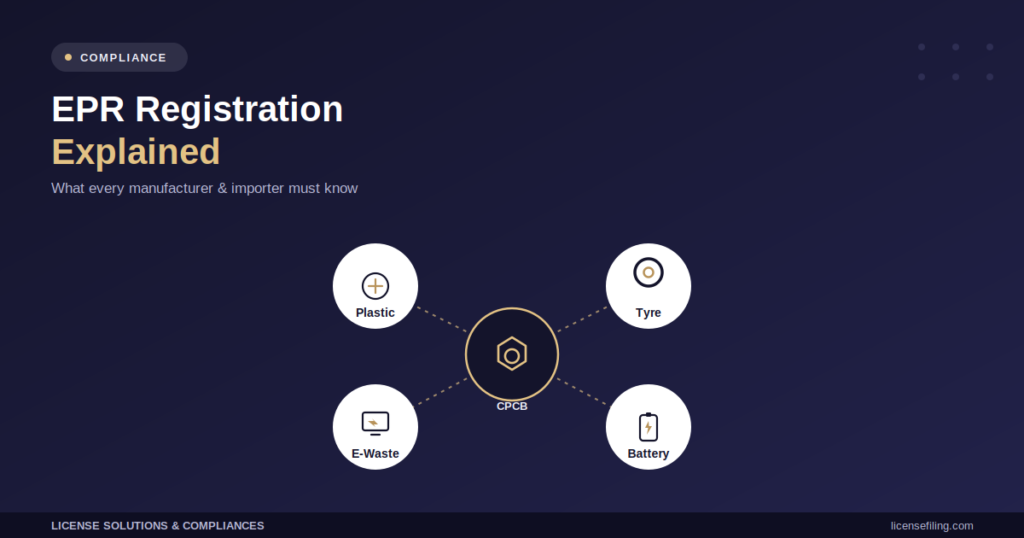
If your business manufactures, imports, or sells products involving plastic packaging, electronic goods, batteries, or tyres, there’s a compliance requirement you can’t afford to ignore: EPR Registration. Extended Producer Responsibility (EPR) has become one of the most actively enforced environmental regulations in India over the past few years, and non-compliance can now result in significant penalties.

Here’s a straightforward breakdown of what EPR Registration means for your business.

What is Extended Producer Responsibility (EPR)?

EPR is a regulatory framework introduced by the Central Pollution Control Board (CPCB) that makes producers, importers, and brand owners (PIBOs) responsible for the environmentally sound management of the waste generated by their products — even after the product has reached the end consumer.

In simple terms: if you put plastic packaging, electronics, batteries, or tyres into the market, you’re responsible for ensuring a portion of that waste is collected and recycled or disposed of correctly.

Who Needs EPR Registration?

  • Producers and importers of plastic packaging
  • Manufacturers and importers of electronic and electrical equipment (e-waste)
  • Battery producers and importers
  • Tyre manufacturers and importers

If your business falls into any of these categories, you are legally required to register on the CPCB’s EPR portal before continuing operations.

The EPR Registration Process

  1. Determine your category — plastic packaging, e-waste, battery waste, or tyre waste
  2. Register on the CPCB EPR portal with your business and product details
  3. Set EPR targets — based on the quantity of products/packaging you introduce into the market
  4. Fulfil obligations — either through your own collection and recycling infrastructure or by partnering with registered Producer Responsibility Organisations (PROs)
  5. File periodic compliance reports with the CPCB

Why Businesses Can’t Afford to Skip This

CPCB has significantly increased enforcement of EPR compliance, and businesses found operating without valid EPR Registration face financial penalties, and in some cases, restrictions on further production or import. Beyond the legal risk, EPR compliance is increasingly becoming a factor that larger buyers and retailers look for before onboarding new vendors or suppliers.

“EPR isn’t just a formality anymore — it’s becoming a prerequisite for doing business with larger brands and retailers who audit their supply chain for compliance.”

How This Connects to Other Compliance Requirements

Businesses dealing with packaged goods often need to look at EPR alongside their LMPC Registration, since both relate to packaging compliance but under different regulatory frameworks. Getting both right together avoids duplicate documentation efforts and keeps your compliance calendar organized.

Final Thoughts

EPR Registration can feel technical and overwhelming, especially with the target-setting and reporting requirements involved. Our team at License Solutions & Compliances helps manufacturers and importers get registered, understand their obligations, and stay compliant with CPCB requirements — without the guesswork.
case studies

See More Case Studies

GET IN TOUCH

Partner with Us for Complete Legal & Compliance Support

We’re happy to answer any questions and help you find the right licensing, compliance, or legal solution for your business.

Your benefits:
What happens next?
1

We schedule your free consultation

2

We review your documents & requirements

3

We process your application & compliance filing

Schedule a Free Consultation